With the new Alpina BMW B7 Bi-Turbo, Alpina presents its fourth generation of automobiles based on the BMW 7-Series. Prominent predecessors include the BMW Alpina B12 6.0 and B7, which raised the bar in the high-performance luxury saloon segment. Newly interpreted and in every way state-of-the-art, the Alpina BMW B7 Bi-Turbo unites exclusiveness, athleticism and comfort in perfect harmony.
POWERTRAIN - FIRST-CLASS IN BOTH PERFORMANCE AND ECONOMY
The fully-aluminium, 4395 cm3 V8 aggregate yields 507 peak horsepower (373 kW) at a moderate 5500rpm, with a maximum torque of 700 Nm available between 3000-4750 rpm. Two especially for Alpina powerplant constructed turbochargers, one located above each of the V8's two cylinder banks, are responsible for the forced induction. The turbochargers operate in parallel, with generously-dimensioned turbine vanes measuring 44mm in diameter.
DRIVETRAIN COMFORT - UNIQUELY SUPERIOR
The Alpina BMW B7 Bi-Turbo is the result of the consistent execution of the Alpina philosophy, in itself the reason why the sharp yet gracious Alpina BMW B7 Bi-Turbo shines so brilliantly in everyday use.
One look at the torque and power diagram is enough to highlight that the Alpina BMW B7 Bi-Turbo will accelerate fiercely yet effortlessly from very low revs. Peak torque is available from an unusually broad range of rpm's, ranging from 3,000 to 4,750 rpm. This wide powerband coupled with the exquisitely geared ZF six-speed automatic sport transmission pampers the occupants with remarkably high levels of smooth drivetrain comfort in every driving situation.
The Alpina SWITCH-TRONIC, which has been programmed to shift exceptionally smooth and comfortable in Automatic mode, offers different shift characteristics for every taste and situation thanks to the additional Sport and Manual modes. Driving the Alpina BMW B7 Bi-Turbo becomes an altogether different experience when using the buttons found on the back of the steering wheel for manually selecting the gears of the automatic transmission. This ensures shifts take place within a few hundred milliseconds and with only minimal interruption to the transmission of power, favourably comparable even to the best twin-clutch transmissions. As a result the Alpina BMW B7 Bi-Turbo sprints from 0-100 km/h in 4.7 seconds, vehemently pressing on to an electronically-limited 280 km/h top speed.
THE SUSPENSION - HARMONIOUS, ACCOMPLISHED, IMPRESSIVELY VERSATILE
Long gone are the days when a purely "hard and sporty" ride was a sought-after attribute of suspension set-ups. Striving for truly neutral handling continues to be the intelligent way forward, yielding the best of what is technologically feasible. In pursuit of this goal, marginally shorter and uniquely calibrated springs reduce front and rear ride height by 15mm and 10mm respectively.
Together with the 21" wheel and tyre combination the suspension is at once sensitive to inputs and direct in its feel, yet free from the harshness of a purely sportsoriented suspension, imparting this large saloon with an agility usually only associated with much smaller sports saloons. The light-weight 21" wheels, with their new interpretation of the Alpina CLASSIC wheel design, are shod with an especially selected staggered MICHELIN tyre set-up: 245/35 R21 front and 285/30 R21 rear. Foregoing Run-Flat technology, conventional tyres are used to ensure a supple, comfortable finesse that is rare today.
DESIGN & INTERIOR - EVOLUTIONARY STYLING, DOWN TO THE LAST DETAIL
At once dynamic, graceful and potent - the silhouette of the Alpina BMW B7 Bi-Turbo is significantly influenced by the evolutionary new design of the 21" Alpina CLASSIC wheels. A turbine-like three-dimensional curve guides each of the 20 spokes from the centre of the wheel to the rim, at which point they have a milled surface. Depending on the angle of the viewer, the rotational speed of the wheels and the light, the appearance of these classic wheels is constantly changing. Of course they continue to possess the refined tyre air valves, safely and attractively hidden away behind the lockable wheel covers.
In true "form-follows-function" fashion, the typical Alpina front integrates the fresh-air requirements of the transmission and engine oil coolers, which are separated out of the main cooler module for improved efficiency. The design of the front and rear spoiler follows clearly aerodynamically-oriented interests, reducing lift at the front and rear by 30% and 15% respectively. Left and right, the exhaust system's two double tailpipes are seamlessly integrated into the rear valance and are witness to the Alpina BMW B7 Bi-Turbo's potency.
Introducing the BMW ActiveE Concept, the latest electric vehicle project under BMW Group's initiative to produce vehicles that explore solutions to minimize environmental impacts while preserving the kinetic driving experience for which BMW has long been known. The BMW ActiveE Concept follows the all-electric MINI E as the second large-scale electric vehicle test program to be conducted in the hands of interested customers.
The BMW ActiveE Concept has allowed BMW to explore new vehicle packaging solutions and components which will be crucial to the success of the Megacity Vehicle. The intelligent integration of drive components within the existing vehicle package of the BMW 1-Series Coupe offers the opportunity to provide four full-size seats and a luggage compartment with a capacity of 200 litres / 7 cu ft. The motor, specially developed for the model and located in the rear axle, delivers 125 kW/170 hp and provides maximum torque of 250 Nm / 184 lb-ft. It accelerates the vehicle in less than 9 seconds from zero to 100 km/h (0-60 mph in approx. 8.5 seconds).
The electric drive system draws its energy from new, advanced lithium-ion battery pack developed jointly by BMW and the co-operation partner SB LiMotive especially for the BMW ActiveE Concept. They enable a range of approx. 160 kilometres (100 miles) in everyday use. An intelligent battery management system helps achieve this range largely independently of external climatic conditions. Additionally, the charging period required for the lithium-ion batteries is very short. On the European power grid, the battery pack can be fully charged in just 3 hours at a wall box with a current of 50 ampere at 230/240 volts. In North America, using a high-current (32 ampere continuous) residential wall box, the charge time is about 4.5 hours.
Innovative technology for sheer driving pleasure without CO2 emissions.
The BMW ActiveE Concept embodies a whole new dimension of purely electrically powered mobility. The dynamic potential and high torque of the drive system, along with the rear-wheel drive which is a hallmark of the brand, guarantees the characteristic sheer driving pleasure which is typical of BMW - but without any CO2 emissions. An impressive range of functions and a high level of suitability for everyday use are additional features of this concept, which defines electro-mobility in true BMW style.
Electric drive: emissions-free, powerful and compact.
The BMW ActiveE Concept offers the prospect of characteristic BMW driving pleasure without exhaust emissions. The requirements for electro-mobility with characteristic BMW properties are being created based on ongoing development in the powertrain. The latest outcome is a new synchronous electric motor tailored to the BMW ActiveE Concept. It offers a high level of efficiency, power delivery, and compact construction.
The maximum output of the new electric drive is 125 kW/170 hp. The maximum torque of 250 Nm / 184 lb-ft is available from a standstill as is typical for electric motors. The torque remains available over an unusually broad load range. Unlike asynchronous electric motors, the new power unit provides a relatively high level of torque even at higher engine speeds and road speeds; at increased load the torque is not reduced abruptly but decreases gradually. The torque curve at higher engine speeds is therefore much more similar to the pattern familiar from combustion engines.
The vehicle concept and drive system provide the agility and dynamic acceleration performance which are characteristic of the BMW 1-Series Coupe. Based on realistic simulations, a figure of less than 9 seconds was measured for the sprint from zero to 100 km/h (0-60 miles in 8.5 seconds), with the 60 km/h mark being reached after less than 4.5 seconds. The maximum speed of the vehicle is electronically limited at around 145 km/h or 90 mph.
Recuperation of energy increases range.
In the purely electric powered BMW, the driver may control deceleration as well as acceleration through the movement of the accelerator pedal. As soon as the driver's foot is removed from the accelerator, the electric motor performs the function of a generator, converting the vehicle's kinetic energy into electric power and storing it in the battery pack. Intensive use of this so-called energy recuperation process by the motor increases the range by up to 20%.
At the same time, a brake torque is created which results in effective deceleration of the vehicle. This response enables a very comfortable driving style, especially at medium and constantly varying speeds. In urban traffic, some 75 percent of all deceleration manoeuvres are initiated without the need for the brake pedal. During Brake Energy Regeneration function, the vehicle's brake lights are illuminated.
The brake effect acts on the rear wheels only. When the driver requires a higher level of deceleration, stepping on the brake pedal engages the conventional hydraulic braking system. If an emergency braking maneuver is required during braking, the Dynamic Stability Control (DSC) system applies selective braking and motor management measures to ensure that safe braking is always guaranteed.
The brake system is fitted with an electric vacuum pump which is activated on demand. Along with the Electric Power Steering (EPS) familiar from the production models of the BMW 1-Series, these features contribute to an increase in the overall efficiency of the vehicle.
Innovative lithium-ion battery pack with its own liquid cooling.
The lithium-ion battery pack specially developed for this vehicle supplies energy to the motor and all other functions of the BMW ActiveE Concept. The high-voltage battery units offer a particularly high storage capacity and durability. For the first time, storage cells are used which were developed especially for use in automobiles by the BMW Group in collaboration with the co-operation partner SB LiMotive. Powerful battery cells are key when it comes to designing production vehicles with electric drive. Through the collaboration of the BMW Group with a joint venture of the companies Bosch and Samsung SDI [SB LiMotive], leading expertise in the area of battery technology and electro-mobility has been brought together. The aim is to use the best available technology in the area of energy storage as part of the development of the Megacity Vehicle.
Another special feature of the battery pack is its outstanding compactness, despite its output and capacity. The arrangement of battery cells, grouped into several modules, is ideal in terms of packaging, functionality and vehicle balance. The battery pack is located where a combustion engine and fuel tank would normally be located. The largest portion of the battery pack in the BMW ActiveE Concept is located where the conventional propshaft and fuel tank would be in the lower section of the vehicle. In addition, a portion of the battery pack is located where the combustion engine would normally reside. Using intelligent lightweight design and the highly-efficient lithium-ion battery cells, vehicle curb weight is limited to about 1800 kg / 3900 lbs.
Characteristic BMW driving experience, space of a BMW 1-Series Coupe.
The positioning of the battery pack shifts the vehicle's center of gravity downwards. Also, the battery cell layout within the vehicle preserves the near 50-50 weight distribution characteristic of BMW vehicles. In this respect, the BMW ActiveE Concept offers ideal conditions for driving experience characterized by a high level of agility.
The optimum positioning of the power electronics above the motor integrated in the rear axle, for reasons of safety and functionality, results in a reduction of trunk capacity. Nonetheless, the BMW ActiveE Concept still has a luggage compartment which provides considerable versatility in everyday use. With a volume of approx. 200 litres / 7 cu ft, it even exceeds the trunk capacity of the BMW 1-Series Convertible with an open top and can hold two 46-inch golf bags, for example.
Reliable and safe: power electronics control and monitor vehicle functions.
The power electronics of the BMW ActiveE Concept regulate the supply of electrical current to the motor at the required amperage and voltage. It also controls the supply of energy to the vehicle power network. By means of a voltage transformer and an intelligent battery management system, a reliable supply of power to all vehicle functions is ensured, including the comfort and entertainment features familiar from the production model of the BMW 1-Series. Drive components, energy supply, and battery pack comply with the integral safety standards for electric vehicles as defined by the BMW Group.
Modern charging technology: fresh energy both swiftly and flexibly.
The consistent development of serial production vehicles with electric drive also includes innovative solutions for flexible, user-friendly charging of the energy storage systems in the vehicle in a way which is appropriate to everyday use. The lithium-ion battery pack of the BMW ActiveE Concept can be recharged using a range of different power sources.
Specific remote control functions via BMW Connected Drive.
In addition to the intelligent remote controlled operation of the auxiliary heating and air conditioning, BMW ConnectedDrive offers additional services specially developed for the BMW ActiveE Concept. The main focus here is on the user-friendly and practically oriented relay of precise information on the condition of the vehicle. No matter how far he is from the vehicle, the driver can obtain details of the charge status of the lithium-ion battery and the range of travel this permits. The remote control functions also provide support in searching for a nearby public charging station.
Design: unmistakably a BMW 1-Series Coupe.
The technology of the BMW ActiveE Concept is highlighted through unique design features. The BMW ActiveE Concept is unmistakably based on the BMW 1-Series Coupe, well-known for its outstanding agility and efficiency. With its powerful proportions, the BMW ActiveE Concept also embodies an especially sporty form. Its side view is dominated by the striking shoulder line and the short overhangs. In addition, the BMW ActiveE Concept boasts striking light alloy wheels which are aerodynamically optimized. The distinctive appearance is partly created by the concept-specific rear apron which is completely closed, demonstrating that the vehicle is entirely emissions-free due to the lack of an exhaust system. There is a recognisable differentiation from the production model of the BMW 1-Series Coupe with the body finish in Liquid White metallic, as well as graphic elements derived from printed circuits in Electric Blue on the hood, doors, roof and trunk lid, as well as the lettering "ActiveE", "eDrive" and "Efficient Dynamics" on the doors and side panels. The following elements also reflect the special character of this electrically powered vehicle: a blue illuminated charging connection behind a translucent filler cap, a glowing blue roof fin and kidney rods finished in blue. Blue rings on the tyres also make for a visual enlargement of the 18-inch wheels.
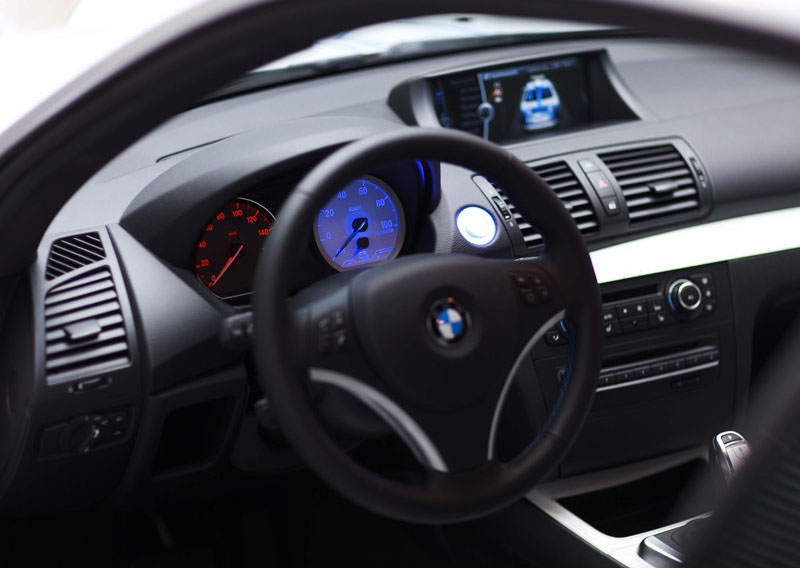
In the interior, individual details highlight the distinctive style of the study and are functionally associated with the electric drive. Among other things, the interior of the BMW ActiveE Concept has special leather seats with embossed graphic elements and blue contrasting stitching. The instrument panel and door trim panels have strips in Liquid White. The decor strip in the instrument panel is finished with a three-dimensional rear-lit ActiveE graphic. The blue illuminated start/stop button and the selector lever knob emblem in White/Blue round off the overall graphic concept. What is more, the instrument panel and the central display have been enhanced to monitor the electric drive.
Teaming up with the BMW 320d, the new BMW 320d Efficient Dynamics Edition is being presented for the first time at the 2009 Frankfurt Motor Show. This unique saloon combines fuel consumption of just 4.1 litres diesel/100 kilometres (equal to 68.9 mpg imp) and a CO2 rating of 109 grams per kilometre in the EU test cycle with engine output of 120 kW/163 hp.
The 2.0-litre four-cylinder diesel engine of this high-tech model boasts an all-aluminium crankcase, turbocharging with variable intake geometry and common-rail direct fuel injection complete with piezo-injectors. With the engine and the entire car modified once again for an even higher standard of efficiency, this unique saloon targeted above all at the German, Italian, French and Spanish markets comes with optimised aerodynamics, an extra-long final drive ratio, and an innovative two-mass flywheel incorporating a centrifugal-force pendulum.
The BMW 320d Efficient Dynamics Edition the most fuel-efficient and lowest-emission car in BMW's current model range. In the fiercely contested midrange segment it is an unparalleled, highly attractive premium offer for the truly demanding and progressive customer focusing primarily on superior economy and the environment, without wishing to forego the sporting driving characteristics so typical of a genuine BMW.
The enhanced efficiency already offered by the existing models in the BMW 3-Series thanks to BMW Efficient Dynamics making these cars superior to their competitors, is now raised to an even higher level in the BMW 320d Efficient Dynamics Edition.
4-cylinder diesel engine with optimised efficiency and superior performance all in one.
The BMW 320d Efficient Dynamics Edition is powered by a four-cylinder diesel engine specifically optimised for even greater fuel economy and emission management and, therefore, for a standard of efficiency never seen before. All this comes from the 2.0-litre four-cylinder power unit with its all-aluminium crankcase, turbocharging and the latest generation of common-rail fuel injection featured with various power stages also in the BMW 316d, the BMW 318d and the BMW 320d. The engine specially conceived for the BMW 320d Efficient Dynamics Edition develops maximum output of 120 kW/163 hp at an engine speed of 3,500-4,200 rpm and peak torque of 360 Newton-metres/265 lb-ft all the way from 1,750 to 3,000 rpm.
The engine stands out in particular through its sporting and dynamic power from low revs. The innovative centrifugal-force pendulum incorporated in the two-mass flywheel, together with the longer transmission ratio, serves to significantly reduce the level of engine speed at all road speeds relevant in practice in the BMW 320d Efficient Dynamics Edition. The shift in load points beneficial to fuel economy and emissions goes together in this case with full maintenance of the spontaneity and running smoothness so typical of a BMW diesel.
Centrifugal pendulum in the two-mass flywheel for smooth and comfortable motoring without vibrations even at very low engine speeds.
To ensure smooth driving characteristics free of vibration also when driving at particularly low engine speeds, the power unit of the BMW 320d Efficient Dynamics Edition features a so-called centrifugal pendulum efficiently compensating any unsmoothness in running characteristics typically encountered at low revs. This innovative component is integrated in the engine's two-mass flywheel where it dampens the vibrations generated under load, thus ensuring comfortable and acoustically optimised development of power and performance all the way from low engine speeds.
This increase in motoring comfort will encourage the driver to use a higher gear more often or, respectively, not to shift back as he otherwise would do. But when accelerating the BMW 320d Efficient Dynamics Edition still offers the driving behaviour and agility so typical of BMW.
The driving dynamics characteristic of a BMW are borne out also by the car's acceleration to 100 km/h in just 8.2 seconds and by the BMW 320d Efficient Dynamics Edition accelerating in fifth gear from 80-120 km/h in 9.6 seconds. Top speed is 225 km/h or 140 mph.
The BMW 320d Efficient Dynamics Edition comes with the complete range of technologies serving to reduce both fuel consumption and emissions and already featured as standard on the other models in the BMW 3-Series. Brake Energy Regeneration, for example, serves to concentrate the generation of electric power for the on-board network on overrun and the application of the brakes, thus avoiding even the slightest increase in fuel consumption. The Auto Start Stop function, in turn, switches off the engine even during a short stop in traffic, avoiding any unnecessary consumption of fuel while idling. The gearshift point indicator on the BMW 320d Efficient Dynamics Edition, to mention yet a further example, tells the driver in good time when to shift gears in the interest of optimum efficiency. And like the detachable climate compressor, EPS Electronic Power Steering operates only when needed, again in the interest of maximum efficiency.
The electric motor featured within the EPS system therefore takes up energy only when really needed for power assistance or when required by the driver. Active cooling through air flap control and tyres with reduced roll resistance also serve to enhance the car's efficiency, and the BMW 320d Efficient Dynamics Edition is likewise fitted with a diesel particulates filter close to the engine. It almost goes without saying, finally, that the BMW 320d Efficient Dynamics Edition fulfils the EU5 emission standard in full.
The fuel economy and emission management also featured in the other models in the BMW 3-Series are combined in the BMW 320d Efficient Dynamics Edition with additional innovations, which, together with the decrease in engine power on the BMW 320d by 10 kW or 14 hp, serve to reduce fuel consumption and emissions to an even lower level, below the CO2 standard of 110 grams per kilometre relevant to taxation in many countries.
These additional features include a longer final drive ratio and the lower chassis and suspension of the car. Newly developed Aero wheel rims in turbine wheel design - the only optical sign of distinction on the car to be seen from outside - improve the level of aerodynamics to an even higher standard, giving the BMW 320d Efficient Dynamics Edition a drag coefficient of just 0.26.
Within the BMW 3-Series the BMW 320d Efficient Dynamics Edition is the so far most consistent implementation of the BMW EfficientDynamics development strategy, offering the motorist who really appreciates the premium character and sporting driving qualities of a BMW 3-Series and at the same time attaches utmost significance to superior economy exactly the right choice in the midrange market segment.
Comparing the efficiency of all models in this segment, BMW, introducing the BMW 320d Efficient Dynamics Edition, is once again moving a step ahead of the competition. And following BMW's general policy, the improvement of efficiency offered by this innovative technology does not even require the payment of a higher price for the BMW 320d Efficient Dynamics Edition, which therefore comes at the same price as the "regular" BMW 320d, which naturally is still included in BMW's model range.
The BMW Vision concept car clearly demonstrates that the EfficientDynamics objectives are fully compatible when applied to a sports car. Conceived as a 2+2-seater with plug-in full-hybrid technology, the unique car combines the performance of a BMW M vehicle with a standard of fuel efficiency and emission management that exceeds even the current levels achieved by the latest small cars. The outstanding result is made possible by the combination of BMW ActiveHybrid components with an extremely economical combustion engine, and outstanding aerodynamic qualities.
BMW Efficient Dynamics Concept is the result of a "clean-sheet" development process to ensure that the correct achievements were made in the areas of efficiency, driving pleasure, technology, and emotional design. BMW Efficient Dynamics Concept is the most comprehensive implementation of the EfficientDynamics philosophy seen so far. The powertrain provides a top speed limited electronically to 155 mph, with acceleration to 100 km/h in 4.8 seconds. Average fuel consumption in the EU test cycle is 3.76 liters/100 kilometers, equal to 62.6 mpg, and the CO2 emission rating is 99 grams per kilometer. CO2 emission management is even more outstanding when driving in the all-electric mode after charging the battery from a plug-in source: Taking all emissions in the generation of electricity into account, as prescribed by the EU formula, the car's emission rating is just 50 grams per kilometer.
The power and performance are made possible by combining a fuel-efficient 3-cylinder turbodiesel with one electric motor on each axle. The intelligent combination of these units, together with precisely controlled energy management, simultaneously enhances the dynamic performance and the efficiency of the car. Overall system output is 356 horsepower, and peak torque is 590 lb-ft. The special arrangement of the two motors and diesel engine allows all-wheel drive when driving in all-electric mode. The result is minimum power loss and a harmonious transmission of the power available under all conditions.
BMW EfficientDynamics Concept for the first time conveys the dynamic look of a BMW sports car to a hybrid vehicle. Developed with decades of experience in Motorsport, the body of this unique sports car is a result of intelligent lightweight technology and aerodynamic efficiency. In the design of the interior, the focus was likewise on both the fascinating driving experience and, in particular, on transparent, hands-on technology and maximum reduction of weight.
Turbo diesel engine with unprecedented specific output.
The combustion engine is a cutting-edge turbodiesel featured for the first time in the BMW EfficientDynamics Concept car. Displacing 1.5 liters on three cylinders, the engine consistently follows the downsizing principle of using a relatively small engine combined with a turbocharger to reduce fuel consumption.
The specific output of 109 hp per liter sets a new benchmark in diesel technology. The power delivered by the turbodiesel is conveyed to the rear axle by means of a double-clutch transmission (DCT). This advanced transmission technology, which already offers a particularly dynamic driving experience in BMW's M3 and Z4 Roadster, allows the driver to shift gears without the slightest interruption of power. BMW EfficientDynamics Concept features a newly-developed version of BMW's DCT with six speeds for maximum efficiency and flexibility.
Two electric motors for full-hybrid drive.
The combustion engine is supplemented by two electric motors. Consistently applying the BMW ActiveHybrid philosophy, development engineers followed the principle of "Best of Hybrid," choosing the optimum combination of a hybrid synchronous motor on the front axle and a full-hybrid system at the rear.
The driver benefits from the efficiency of the electric motors over a far wider speed range than with a conventional hybrid car. The rear axle comes with a second-generation full-hybrid system corresponding to the technology in the BMW ActiveHybrid 7 production model. The compact electric motor positioned between the diesel engine and the DCT outputs a consistent 33 horsepower and is able to reach a peak of up to 51 hp. Maximum torque for the rear electric motor is 214 lb-ft, the power, either supporting the diesel engine or in all-electric motoring.
The engine, a hybrid synchronous motor, offers continuous output of 80 horsepower and peak torque of 162 lb-ft. Extra power of 112 horsepower is available for a period of up to 30 seconds, and, for a 10-second "burst," the electric motor is able to develop 139 horsepower. The power is transmitted through a 2-stage, single-speed reduction gearbox.
The lithium-polymer battery for electrical energy.
The energy cells featured in BMW EfficientDynamics Concept are housed in a chassis element running from front to rear through the middle of the car. The front unit is the lithium-polymer complex, an ongoing development of the lithium-ion battery. Overall, BMW EfficientDynamics Concept comes with a total of 98 lithium-polymer cells, each offering a capacity of 30 amp/hours and developing continuous output of 600 Amps at a voltage of 3.7 V. For a period of 30 seconds, each cell is even able to develop maximum output of 1,200 Amps.
The serial arrangement of the lithium-polymer cells serves to generate nominal voltage of 364 volts, the gross storage capacity of the battery is 10.8 kW/h. With an unusually high discharge capacity of 80 percent, the battery delivers 8.6 kW/h for driving the car. This superior performance comes on overall weight of the entire energy storage system of just 187 lb. A further advantage is that through their optimum dimensions tailored to the specific qualities and features of the car, the lithium-polymer cells, together with the operating strategy chosen with a concept of "forward looking" energy management, reduces the thermal load acting on the battery to such an extent that there is no need for active cooling.
The Plug-in solution: convenient charging of the electric power system from a conventional power socket.
Brake Energy Regeneration captures electric power generated while driving without additional fuel consumption, which is subsequently used to supply power to the electric motors and on-board network. A further option is to connect the lithium-polymer cells to a conventional power socket for a simple and efficient charge process, using a plug-in connector in the front-right wing of the car. Connected to a standard EU power outlet (220 V, 16 Amps), the system requires a maximum of 2 ½ hours to fully charge the lithium-polymer cells. And wherever a power source with higher voltage and amperage (380 V, 32 Amps) is available, the charge time is an even shorter 44 minutes.
The Fuel efficiency and emission management opening new dimensions in hybrid technology.
The power delivered by the two electric motors and single diesel 3-cylinder engine gives the BMW EfficientDynamics Concept a level of performance superior to anything provided so far by a hybrid vehicle. Acceleration from a standstill to 100 km/h, for example, comes in just 4.8 seconds and the car could exceed its electronically-limited 155 mph top speed.
The fuel efficiency and emission management now reach a standard only achieved, if at all, by far less powerful small cars conceived for city traffic and short distances. Applying the criteria of the EU test cycle, BMW EfficientDynamics Concept offers average fuel consumption equal to 62.6 mpg. CO2 emissions, in turn, are 99 grams per kilometer. These consumption and emission figures are measured on a consistent internal power balance, meaning that the batteries and storage media for electrical energy maintain the same charge level throughout the entire test cycle (with the same level at the beginning and end) and are charged while driving only by the car's on-board systems.
As a plug-in hybrid, BMW EfficientDynamics Concept is able to cover the entire drive cycle for measuring fuel consumption also with its combustion engine completely switched off. Then, to subsequently charge the lithium-polymer cells to the same status as when setting off, all the driver has to do is connect the car to an external power grid. To determine the consumption of electric power, the only requirement is to compare the charge level of the battery before and after the test cycle. Applying this measurement process, the BMW Efficient Dynamics Concept car consumes 17.5 kW/h per 100 kilometers, equal to a CO2 emission rating of just 50 grams per kilometer in the EU test cycle.
To determine the total volume of CO2 emissions when driving in the all-electric mode, new legal standards for measuring the level of fuel consumption are currently being prepared for hybrid and electric cars with a plug-in power supply. Applying this calculation method, the CO2 emission ratings generated by BMW Efficient Dynamics Concept are reduced further to just one-third of the original figure of 99 grams per kilometer. Clearly, this significant reduction of emissions opens up a new dimension in BMW's EfficientDynamics development strategy in this unique concept car.
BMW EfficientDynamics Concept also takes a new approach in its design and streamlining, the body and the interior clearly expressing the unique combination of supreme efficiency and the sporting performance of the brand. Following BMW's design language, this concept car visualizes both highly efficient aerodynamics and intelligent lightweight construction.
In its design, BMW Efficient Dynamics Concept differs from the usual low-emission car concepts. The principle of "form follows function" is not just for the overall look of the car, but embraces each and every detail. Measuring 48.8" in height and boasting a sweeping, arch-like roofline, BMW EfficientDynamics Concept offers the slender silhouette of a classic Gran Turismo. With the combustion engine fitted in front of the rear axle, the designers have succeeded in giving the car a very low front end, with the flow of air being further smoothened by active louvers in front of the radiator, which close completely when the need for cooling air is low. This efficient function follows in the footsteps of the active air flap control already used as a feature of BMW EfficientDynamics in some of BMW's current production models. As a further highlight, BMW EfficientDynamics Concept guides air smoothly and exactly as required into the car through an active air intake at the front.
Overall vehicle concept for a drag coefficient of just 0.22.
To further optimize the aerodynamic qualities of the entire vehicle and keep rolling resistance to a minimum, BMW Efficient Dynamics Concept comes with tires and wheels of quite unusual size on a sports car. The tires measure 195/55, while large 21-inch wheels provide a contact surface on the road otherwise offered only by a much wider tire. In combination with the sophisticated axle geometry, this ensures agile driving behavior.
The extra-large wheel covers extending over part of the tire flanks add to the unique, very different look of BMW Efficient Dynamics Concept from the side. The blade profile integrated in the wheels serves furthermore to reduce the negative effect of the turning wheels on the overall aerodynamics of the car. In all, these features optimizing the aerodynamic qualities of the car give the BMW EfficientDynamics Concept car a very low drag factor (CX) of just 0.22.
Technological look as a strong impression of intelligent lightweight construction.
In both exterior and interior design, BMW EfficientDynamics Concept stands out clearly as a strong spearhead in technology. Many components of the vehicle are presented in full view expressing the "transparent" character of the car as a powerful visual feature of lightweight technology. The chassis and suspension of BMW EfficientDynamics Concept are made completely of aluminum; the roof and the outer skin on the doors are made almost completely of a special polycarbonate glass automatically darkening as a function of the light shining on the car.
Measuring 181.1" in length, 74.8" in width and 48.8" in height, this unique concept car offers ample space for up to four passengers and their luggage. Thanks to the consistent lightweight construction strategy applied on the car, curb weight is 3,076 lb, with the center of gravity remaining very low. In its power-to-weight ratio, the BMW EfficientDynamics Concept car is far superior to all other hybrid cars, achieving the same standard as extremely dynamic sports cars with a conventional combustion engine.
Carrying a maximum payload of 981 lb, this unique 2+2-seater is fully suited for everyday traffic. Luggage capacity of 5.3 cu ft, in turn, allows the driver and passengers to conveniently take along two golf bags. And to meet additional loading requirements the backrests of the two rear seats may be tilted down individually to provide extra storage space.
Interior: innovative lightweight construction and unprecedented orientation to the driver.
Innovative layering technology provides an unprecedented symbiosis of function and stylish shapes intentionally reduced to a minimum, consistently implementing and visualizing the lightweight principle also inside the car.
Specific components such as the central air vent not only serving to enhance motoring comfort but also acting as part of the cockpit, perform several functions in one. This multi-functionality is then presented visibly within the car, the use of particularly sophisticated materials providing a highly attractive combination of innovation in technology and quality clear to the eye and the touch of the surface.
This interaction of lightweight construction and individual well-being also comes out clearly in the design of the controls and switches, with a leather band, for example, running round the aluminum gear selector lever on the center console. Materials combining lightweight technology and all the qualities required are also to be admired all round the cockpit of BMW Efficient Dynamics Concept, giving the car an unusually generous feeling of space for a 2+2-seater. The body-contoured seats, for example, are made up of a kevlar shell, a backbone structure, and seat padding with personalized fillings. Clearly, this combination alone ensures comfort at a minimum weight. The driver's and front passenger's seats are connected firmly to the center console to form a joint interior "landscape", while the rear seats anchored on the floor would appear to be hovering in space. Natural materials and light colors on the seat upholstery and all interior linings underline the light, sophisticated and sustainability-oriented atmosphere within the passenger compartment.
The instrument panel is deliberately padded only where technical components have to be appropriately covered, thus making an important contribution to passenger safety in the event of a collision. The instrument cluster played a fundamental role right from the start in the design process, serving as the starting point for all surfaces within the interior and thus creating a particularly powerful rendition of that driver orientation typical of BMW.
Innovative light technology: providing clear signals to the outside and offering soothing ambient illumination inside in a unique symbiosis.
LED lights at both the front and rear end of BMW Efficient Dynamics Concept provide an innovative combination of the symbols typical of the brand and clear design language oriented towards trendsetting technology. The distinctive look of the dual round headlights characteristic of a BMW is emphasized in particular by the use of LED technology. The rear lights are integrated also in their function into the design of the entire rear section, forming part of the rear air deflector and thus merging completely into the rear contour.
Extremely flat and compact, the rear lights are made up of innovative LED units forming a smooth and consistent red surface when not in use. Only when used do the respective light chambers take on the appropriate color such as yellow on the direction indicators. This innovative light technology also provides an intense symbiosis of the exterior and interior, again promoting and further refining the driving experience.
This is also why the ambient illumination of the interior comes with new features and qualities, the light sources within the passenger compartment being fed from the positioning lights at the side, the rear lights and the brake lights, thus changing the atmosphere created by the lights within the car as a function of driving conditions.
The optical impression conveyed by BMW Efficient Dynamics Concept also results in other areas from the symbiosis of the exterior and interior, eliminating the conventional barriers between the two. The lines within the interior, for example, continue on to the innovative design of the engine compartment lid, while in its shape the third brake light positioned higher up on the car follows the structure of the glass roof and tapers to the outside where the roofline moves down gently to the rear.
Overhead doors for convenient access to all seats.
The doors on BMW Efficient Dynamics Concept open up like bird's wings, turning on pivots in the front roof column at the level of the side direction indicators. Since the car has no B-pillars, the large door cutouts ensure convenient entry also to the rear seats. The pivots on the doors also provide the base for the exterior mirrors, thus forming an ideal combination of function and aesthetic design. The structure of the doors is also characterized by several layers of materials on top of one another and the optical and functional symbiosis of the interior and exterior this technology is able to offer. Made up of three layers, the overall structure comprises the outer glass surface, an interim load-bearing layer, and the interior cover with its particularly smooth shapes and fl owing forms clearly visible to the passengers, layering technology again, therefore, opening up new perspectives.
The large glass surfaces extending far down on the body also provide a strong optical impression of the low seating position close to the road. And at the same time a stable sidebar ensures the body stiffness and crash safety naturally required on every vehicle. Flowing to the inside at its central point, this safety element also serves as an armrest. This interplay of the three layers also helping to minimize the weight of the car continues on the trim bar running along the door and extending out of the armrest, finally flowing into the outer door opener on its path from inside to outside.
It is agile, versatile and modern character, the BMW X1 guarantees a new driving experience in the premium compact segment. It expands and enhances the range of BMW X models by yet another innovative vehicle concept.
Through its body design the BMW X1 demonstrates self-confident elegance, a versatile and sporting character, as well as spontaneous agility. For the first time the features and characteristics of a BMW X model are carried over in modern style into a unique vehicle in the premium compact segment.
The interior of the BMW X1 is characterised by clear function and trendsetting, modern style. The driver orientation so typical of BMW is additionally accentuated by the forward-pushing lines within the cockpit area. Sophisticated materials and natural colours accentuate the youthful and dynamic flair of the vehicle. The elevated seating position, a generous feeling of space, the wide range of storage options and the variable interior offer ideal conditions for enjoying the BMW X1 both in an urban environment and beyond, with agility, spontaneity and versatility of the highest calibre. Three full-sized seats at the rear offer generous space and freedom of movement. The rear-seat backrest is adjustable for angle and folds down in a 40/20/20 split. Luggage compartment capacity may be increased from 420 litres/14.7 cu ft to a maximum of 1,350 litres/47.3 cu ft. An electrically operated Panorama glass roof is available as an option.
The modern drivetrain technology gives the BMW X1 superior performance and supreme efficiency all in one. Depending on the model variant, the driver benefits from powerful, economical and low-emission gasoline and diesel engines, BMW's intelligent xDrive all-wheel-drive technology, as well as a wide range of BMW EfficientDynamics features including Brake Energy Regeneration, Auto Start Stop, and a gearshift point indicator. The BMW X1 sDrive18d with rear-wheel drive and average fuel consumption to the EU standard of 5.2 litres/100 kilometres (equal to 54.3 mpg imp) and a CO2 rating of 136 grams/ kilometre offers the highest standard of efficiency all round.
The cutting-edge suspension technology featured in the BMW X1 comprises a double-joint thrust bar or, respectively, an aluminium double-joint tiebar axle at the front and a five-arm rear axle in lightweight steel, high-precision power steering, high-performance brakes, Dynamic Stability Control including Dynamic Traction Control and, as an option, Performance Control acting on the brakes for particularly dynamic driving behaviour.
The BMW X1 features a special body structure designed from the outset for maximum occupant safety. Standard features include three-point inertia-reel seat belts all round, frontal and side airbags as well as head airbags at the side, adaptive Brake Lights and daytime driving lights. Xenon headlights, Adaptive Headlights and a High-Beam Assistant are all available as an option.
In conjunction with the optional Business and Professional navigation systems, the BMW X1 is equipped with the latest generation of BMW iDrive including a Controller and direct selection buttons on the centre console, a Control Display harmoniously integrated in the instrument panel, and favourite buttons beneath the control panel for the air conditioning featured as standard. The most sophisticated HiFi systems are available as an alternative to the audio system fitted as standard and the AUX-In port likewise featured as standard may be supplemented by a USB interface. Numerous driver assistance systems and the wide range of BMW ConnectedDrive services are also available.
The new BMW 7-Series already sets the benchmark in luxury performance motoring - and now BMW is moving up the standard of maximum exclusivity and supremacy in this supreme class to an even higher level, following a completely new definition: The new BMW 760i and the new BMW 760Li are taking over the top position within BMW's model portfolio, representing the highest level of motoring refinement in their segment.
The heart and foundation of this exceptional new standard comes from the twelve-cylinder power unit featured in both top models in the BMW 7-Series. Developed as a completely new engine from the ground up, the V12 is a masterpiece of modern engine technology. Superior power of 400 kW/544 hp comes at an engine speed of 5,250 rpm, with maximum torque of 750 Newton-metres (553 lb-ft) from just 1,500 rpm.
Combined with the likewise brand-new eight-speed automatic transmission, this twelve-cylinder offers not only unparalleled motoring refinement, but also supreme driving dynamics through its ability to convert seemingly unlimited power reserves spontaneously and with precise control at all times into supreme driving dynamics.
The drivetrain with all its technical features is a masterpiece of supremacy in every respect. This applies both to the 6.0-litre all-aluminium power unit with TwinPower Turbo Technology, High Precision Injection with fuel injected directly into the combustion chambers, and to BMW's infinite double-VANOS camshaft adjustment as well as the eight-speed automatic transmission featured for the first time in a BMW.
Benefiting from all these technologies, the new BMW 760i and the BMW 760Li offer a new standard of motoring refinement, dynamic performance and all-round efficiency in a vehicle with this kind of power and output. Acceleration to 100 km/h comes in just 4.6) seconds, average fuel consumption in the EU test cycle is 12.9) litres/100 kilometres on the new BMW 760i.
In determining the cars' fuel consumption, BMW's engineers have already taken the stricter EU5 emission standard into account, meaning that with the cars' performance improving significantly fuel consumption is down by approximately 4.5 per cent versus the former model.
The new BMW 7-Series: the perfect saloon for supreme motoring refinement.
Boasting superior suspension technology, innovative driver assistance systems and luxurious comfort, as well as a combination of elegance and sporting performance borne out clearly by the car's design, the BMW 7-Series offers all the qualities required to enjoy a truly incomparable driving experience with a new twelve-cylinder power unit of a standard never seen before.
In addition to these outstanding technologies, the BMW 760Li features air suspension including self-levelling on the rear axle. And as an option both models are available with Integral Active Steering offering speed-related adjustment of the steering angle on the rear wheels. With this enhanced steering function both front and rear, particularly the cars' grand touring comfort on the rear seats reaches an even higher level, above all when changing lanes at high speeds.
The supreme grand touring comfort offered by the new top-of-the-range models in the BMW 7-Series is further underlined by comfort seats, BMW's navigation system Professional, automatic air conditioning with four-zone control, cruise control complete with an automatic brake function, Park Distance Control, and Automatic Soft Close on the doors all featured as standard.
The innovative driver assistance systems available as an option include Lane Change Warning, Lane Departure Warning, Active Cruise Control with Stop-&-Go function, BMW Night Vision with detection of individual persons, the BMW Head-Up Display, a back-up camera and the Side View system. And to supplement the bi-xenon headlights as a further option, BMW offers the High-Beam Assistant and Adaptive Headlights including Bending Lights, variable light distribution and adaptive headlight range control, setting new standards for safe driving at night.
The Design: discreet signals on the outside, stylish exclusivity inside.
The outstanding looks of the BMW 760i and BMW 760Li benefit from the harmonious combination of elegance, sportiness and natural presence so characteristic of the new BMW 7-Series in its design. Offering 14 centimetres or 5.5" longer wheelbase, the extended version allows particularly comfortable access to the rear seats. And thanks to the unique design of the roofline and C-pillar contours, the side view of the car, despite the extra headroom for the rear-seat passengers, maintains the same overall impression as on the "regular" saloon with its "normal" wheelbase. Both body versions, incidentally, come with the longest wheelbase in their respective segments.
Visual reference to the V12 power unit on the outside of the BMW 760i and the BMW 760Li is similarly stylish and discreet. The kidney grille for the radiator boasts an extra-wide chrome frame in slightly concave design as well as bars extending powerfully to the front. From the side, 19-inch light-alloy wheels available exclusively on these models as well as the V12 model designation on the chrome-plated gills with their integrated side direction indicators at the transition point between the front side panel and the driver's and, respectively, front passenger's door likewise serve to identify these very special models.
An additional chrome bar between the unique dual tailpipes on the exhaust system provides a special sign of distinction at the rear of both models. The exhaust tailpipes integrated in the rear air dam at the right and left, in turn, are made up of two adjacent, rectangular pipe units embellished with chrome trim and cut at a slight angle, flush to their surrounds.
The inside of the BMW 760i and the BMW 760Li the luxurious ambience is supplemented by various design features tailored specifically to these two models and matched in perfect harmony, again expressing the exclusive character of the V12 models. Stainless-steel door entry trim with an illuminated V12 cover, the instrument panel finished in nappa leather and surrounded by elegant seams, the roof lining and sun visors in alcantara as well as top-quality wood trim in exclusive burr walnut with individual inlays help to give the BMW 760i and the BMW 760Li a further stylish sign of distinction versus the other models in the BMW 7-Series.
The new V12 power unit: perfection as the underlying principle, innovation as the driving power.
The twelve-cylinder power unit in a BMW 7-Series Luxury Performance Saloon guarantees a driving and travel experience quite unique in every respect. No other engine offers such an outstanding combination of power and refinement, no other power unit provides the same supreme standard of prestige.
Now these features come out even more clearly, with BMW's new V12 offering significantly more power and torque compared with their predecessors, optimising engine response and the ongoing surge of power, and further refining the engine's acoustics. The progress achieved in this way is clearly recognisable right from the start.
These features also stand out clearly from the BMW 750i which, with its modern V8 featuring TwinPower Turbo Technology and High Precision Injection, as such already offers the power and performance of a conventional twelve-cylinder.
Hence, the new V12 maintains the outstanding position of BMW's twelve-cylinder models also in the new generation of the BMW 7-Series, giving the driver of a BMW 760i and, respectively, a BMW 760Li all the assurance of absolute supremacy in the luxury class. Yet a further point is that the new engines combine the outstanding qualities of a V12 with up-to-date efficiency, offering a level of fuel economy and emission management even better than eight-cylinder models in the same segment as the BMW 7-Series.
The unique status of the twelve-cylinder as an incomparably powerful and, at the same time, refined power unit is based on a construction and design principle which offers perfect conditions for supreme power and performance achieved without the slightest effort. Benefiting from an angle of 60° between the two rows of cylinders, the V12, in its supreme elimination of vibrations, comes closer to the highest standard conceivable in physics than any other engine.
All components and design features on the all-aluminium engine block are built and constructed for supreme stiffness on minimum weight. Using a closed-deck structure combined with bolts holding the cylinder head down on the floor plate of the crankcase, the engine, to mention just one example, ensures maximum stability on the cylinder liners. Double bolts on the main bearings with an additional connection to the side panels through threaded support bushes and bolts reduce the influence of lateral forces from the crankdrive on the crankcase.
The new V12 power unit comes with 5,972 cc maintaining exactly the same cylinder volume as on the former engine. Displacing 497.7 cubic centimetres per cylinder, the engine therefore offers exactly the right size and dimensions acknowledged by engine specialists as absolutely ideal. Bore of 89 mm/3.50" and stroke of 80 mm/3.15" provides a ratio between these two parameters of 0.9, while the compression ratio is a remarkably high 10.0 : 1 quite unusual on a turbocharged power unit.
Introduction of TwinPower Turbo Technology on the twelve-cylinder.
BMW's new twelve-cylinder comes with a number of special technical features serving to capitalise on the potential it offers through its design principle and basic structure. In particular, this includes the first-ever use on a twelve-cylinder of TwinPower Turbo Technology and High Precision Injection with gasoline injected directly into the combustion chambers.
Featuring this combination of superior technologies already to be admired on BMW's six- and eight-cylinders, responding sensitively and directly even to small movements of the gas pedal, maintaining a consistent torque curve and offering a level of fuel economy and emission management quite unusual for an engine of this calibre, the new twelve-cylinder again stands out from the competition in every respect.
Thanks to the small cylinder angle of just 60°, the two exhaust gas turbochargers developed specifically for the new V12 fit in compact arrangement on the outside of the two rows of cylinders, each supplying six cylinders with compressed air.
The turbochargers stand out in particular through their unusually good compressor and turbine efficiency - and through their particular position they provide ideal conditions for keeping the pipes between the exhaust manifold and the turbochargers short and straight for ideal flow conditions. Central supply of turbocharger air into the air collector, in turn, helps to optimise both the engine's acoustics and charge cycle. The exhaust gas manifolds identical on each row of cylinders come in each case with two three-in-one connections geared to the engine's firing sequence. In combination with the catalytic converters optimised for minimum counter-pressure, this special configuration of the exhaust gas manifolds sets the foundation for outstanding spontaneity in following the gas pedal as well as supreme power and torque coming from the twelve-cylinder.
Peak torque now increased to 750 Newton-metres or 553 lb-ft comes at just 1,500 rpm and is maintained consistently all the way to 5,000 rpm. Compared with the former engine, this means an increase in torque by 25 per cent now developed at an engine speed approximately 2,300 rpm lower.
Engine power is also built up more quickly than on the previous engine, as is borne out by the much steeper power curve leading up to maximum output of 400 kW/544 hp at just 5,250 rpm.
Intelligent solution for even more power and supremacy.
The introduction of TwinPower Turbo Technology raises the twelve-cylinder to a level of output and torque a naturally-aspirated power unit would achieve only with much larger displacement. The increase in engine size and weight inevitable in such a case, together with negative effects on the centre of gravity, fuel consumption and the agility of the car, are all avoided most efficiently and intelligently through turbocharger technology.
To reduce counter-pressure the exhaust system comes on the underfloor with largely straight pipes and manifolds increased in size to the largest possible diameter. Exhaust flaps around the silencer masterminded by the electronic control unit as a function of engine maps provide exactly the right engine sound precisely geared to current driving conditions. When idling, therefore, the V12 remains absolutely silent, not emitting any noise at all. The same applies to cruising conditions, with only very discreet sound from the engine being emitted to the outside. So it is only at higher engine speeds that the driver receives appropriate acoustic feedback on the development of power, with the engine providing its muscular V12 sound when accelerating fast and under full power. Again, this special sound effect under such dynamic conditions authentically reflects both the capacity of the engine and the intensity of power coming from within the engine compartment, characterising the dynamic qualities of BMW's twelve-cylinder.
Optimised combustion and maximum efficiency ensured by High Precision Injection.
BMW High Precision Injection is a second-generation direct injection technology serving to optimise the combustion process and use the energy contained in the fuel with maximum efficiency. Piezo-injectors positioned in the middle of the cylinder head allow particularly precise dosage of the fuel injected into the combustion chambers.
In combination with TwinPower Turbo Technology, High Precision Injection is featured in all gasoline engines in the BMW 7-Series. And now, in the new V12 power unit, this technology ensures particularly efficient and clean combustion as the starting point for a level of fuel economy and emission management quite unparalleled in this class of performance.
The fuel injected in this process spreads out in conical form, thus burning in a particularly smooth and clean process. This, in turn, has a positive effect on engine emissions and sound, the cooling effect of the fuel/air mixture provided by direct fuel injection helping in addition to achieve a higher compression ratio than on a turbocharged engine with manifold injection. The bottom line, therefore, is an even higher degree of engine efficiency generating more power on less fuel.
In their configuration and structure, the cylinder heads largely follow the particular position of the injectors and spark plugs as well as the combustion process provided by High Precision Injection. Short combustion phases optimised for maximum efficiency build up a high level of pressure and temperature requiring optimised cylinder head geometry and an effective flow of coolant. The cylinder head components cast in a gravity process stand out in particular through their very high level of stiffness, while the cylinder head covers are made of aluminium and come with rubber profile seals.
Double-VANOS and volume flow-controlled oil pump for maximum efficiency.
Again in typical BMW style, the new twelve-cylinder comes with double-VANOS for infinite adjustment of camshaft control timing. This ensures part load running conditions with a high level of residual gas and reduced throttle loss for maximum fuel efficiency.
A further advantage of double-VANOS is its support in giving the engine a particularly direct response. Joined in a thermal process, the camshafts come with forged cams, additional triple cams on the intake side serving to drive the high-pressure fuel pumps. The valves on the exhaust side, in turn, are filled with sodium for optimum cooling and come with chrome-plated shafts.
The supply of oil to the new twelve-cylinder has also been optimised, the volume flow-controlled oil pump operating on individual demand with maximum efficiency: The six-chamber pendulum-slide pump delivers only as much oil as the engine requires at any given point in time under specific driving conditions.
An oil level sensor is integrated in the oil sump made of pressure-cast aluminium. And instead of a manual oil dipstick, an oil level indicator in the instrument cluster also operating while driving informs the driver of the oil level whenever required.
The new twelve-cylinder models in the BMW 7-Series again feature a wide range of technologies for minimum fuel consumption and emissions based on BMW's strategy of EfficientDynamics. These include Brake Energy Regeneration, electric coolant pumps operating on demand, and the volume flow-controlled oil pump further optimising the balance of load performance and fuel consumption.
With an increase in engine output versus the former models by 22 and an increase in maximum torque by 25 per cent, the average fuel consumption determined in the EU test cycle has been reduced to 12.9) litres/100 kilometres. The emission rating of the BMW 760i is 299) grams per kilometre.
The engine coolant system on the new twelve-cylinder excels through consistent integration of all pipes in the crankcase, optimised cross-sections and the surface structure ensuring a maximum heat exchanger function helping to warm up the engine far more quickly than before on the former power unit.
The arrangement of the coolant inlet immediately next to the main inlet duct for supplying oil serves in addition to connect the two media in thermal terms, again helping to warm up engine oil and maintain the ideal temperature at all times.
The flow of coolant is separated on the two rows of cylinders, in each case running diagonally from the rear outside to the front inside. And last but not least, the arrangement of the outlets again helps to consistently spread out and maintain the temperature level over a wide range of engine speed.
The BMW's outstanding competence in twelve-cylinder technology: a long tradition of supreme performance.
This is the fourth time that a twelve-cylinder power unit marks the top end of the engine portfolio featured in the BMW 7-Series. And indeed, every new generation has further reinforced BMW's position as the leading manufacturer of luxury performance saloons. A BMW 7-Series with a twelve-cylinder power unit stands for exclusivity, supremacy and, not least, genuine innovation, the top-of-the-range engines providing the highest standard also on account of the maximum demands they are expected to meet right from the start in the development process.
The BMW's outstanding competence in the development and production of twelve-cylinder power units is based on a long tradition extending all the way back to the year 1925 when the Company for the first time hit the headlines by building an aircraft engine with twelve cylinders. Back then BMW's V12 developed maximum output of 750 hp, with two BMW twelve-cylinders powering the Dornier Wal seaplane just five years later in its record flight across the Atlantic.
In the second half of the 20th century BMW became the pioneer in introducing the twelve-cylinder in the most outstanding luxury cars. The BMW 750i launched in 1987, for example, was the first German twelve-cylinder saloon after the war. In the years to follow a long story of success in motorsport likewise contributed to the exceptional reputation of BMW's twelve-cylinders. The BMW V12 LMR, for example, dominated the racing scene right from the start in its very first race in 1999, the 12 Hours of Sebring, and in the same season clinched overall victory in the 24 Hours of Le Mans.
World debut: eight-speed automatic transmission in the new BMW 760i and the new BMW 760Li.
The unique qualities of the new V12 power unit with TwinPower Turbo Technology and High Precision Injection are combined in the new BMW 760i and the new BMW 760Li with an equally innovative concept for the transmission of power: the newly developed eight-speed automatic transmission making its world debut in a BMW production car. Ideally tailored to the power and performance characteristics of the twelve-cylinder power unit, the eight-speed automatic transmission combines supreme gearshift comfort, sportiness and efficiency at a level never achieved before.
The new 8-speed automatic transmission excels through the innovative configuration of gears and gearsets allowing the use of additional gears and a larger range of gear increments than on the former 6-speed automatic transmission, without any negative effects on the size of the transmission, its weight, and the inner efficiency of the system.
The eight forward gears and the reverse gear all incorporate four simple gearsets and five gearshift elements. The innovative arrangement of these components seen for the first time on an eight-speed automatic transmission ensures that only two clutches are open in each gear at any given point in time, significantly reducing frictional losses under all driving conditions to an absolute minimum.
The optimum gearset configuration as the result of scientific research.
To achieve significant progress over BMW's proven six-speed automatic transmissions, BMW's engineers right from the start initiated an in-depth development process providing the basis for the new transmission. The initial consideration was that particularly the improvement of efficiency as desired was only possible with a transmission system offering an even larger number of gears and a wider range of gear increments versus a six-speed automatic transmission. A further objective was to keep the number of additional components to a minimum in order to optimise the inner efficiency of the system.
Triple progress with two additional gears: gearshift dynamics improved, comfort optimised, efficiency maximised.
With the number of gears being increased to eight, the individual steps between gears are smaller than before, despite the overall range of gear increments. Clearly, this benefits the sporting character of the transmission and, as a result, the dynamic nature of the car again in typical BMW style.
While accelerating the harmonious balance of gear ratios provides a very smooth and consistent increase in road speed, a feature corresponding ideally with the ongoing surge of power from the new V12 and again confirming the unparalleled supremacy of the BMW 760i and the BMW 760Li.
A further advantage of the small gear increments is the enhancement of gearshift comfort in BMW's most outstanding Luxury Performance Saloon, with only a slight change in engine speed when shifting from one gear to another.
Flexible, up-to-date, oriented to the future.
With the number of transmission components being increased only slightly over the former six-speed automatic transmission, the new eight-speed automatic offers an unusually high level of internal efficiency. So-called gear-mesh efficiency, for example, is more than 98 per cent in each gear. And being configured as a direct gear, sixth gear reduces frictional losses to zero.
The low weight of the new transmission virtually identical to that of the former six-speed automatic likewise benefits the overall efficiency of the car, with the integration of an additional gearset being compensated by the optimisation of weight in other areas.
In all the minimum converter slip, the high degree of internal efficiency, low frictional losses with only two clutches open at a time, the longer transmission ratios on the higher gears and the transmission management giving preference to low engine speeds at all times offer a reduction of fuel consumption versus the former six-speed automatic by approximately 6 per cent.
The new transmission may be combined with all kinds of engines and levels of performance, and may be integrated not only in cars with rear-wheel drive, but also in all-wheel-drive models. At the same time the eight-speed automatic transmission may be combined with hybrid drive, making it part of BMW's Active Hybrid technology combining an eight-cylinder gasoline engine with an electric motor.
The 8-speed automatic transmission perfectly supplements both the supremacy and the dynamic character of the power unit. At the same time the exceptional efficiency of both top models in the BMW 7-Series results not just from the V12 power unit, but also from the transmission. Innovations developed in the context of BMW EfficientDynamics allow this luxury saloon to combine acceleration to 100 km/h in 4.6) seconds with average fuel consumption in the EU test cycle of 12.9) litres/100 kilometres.